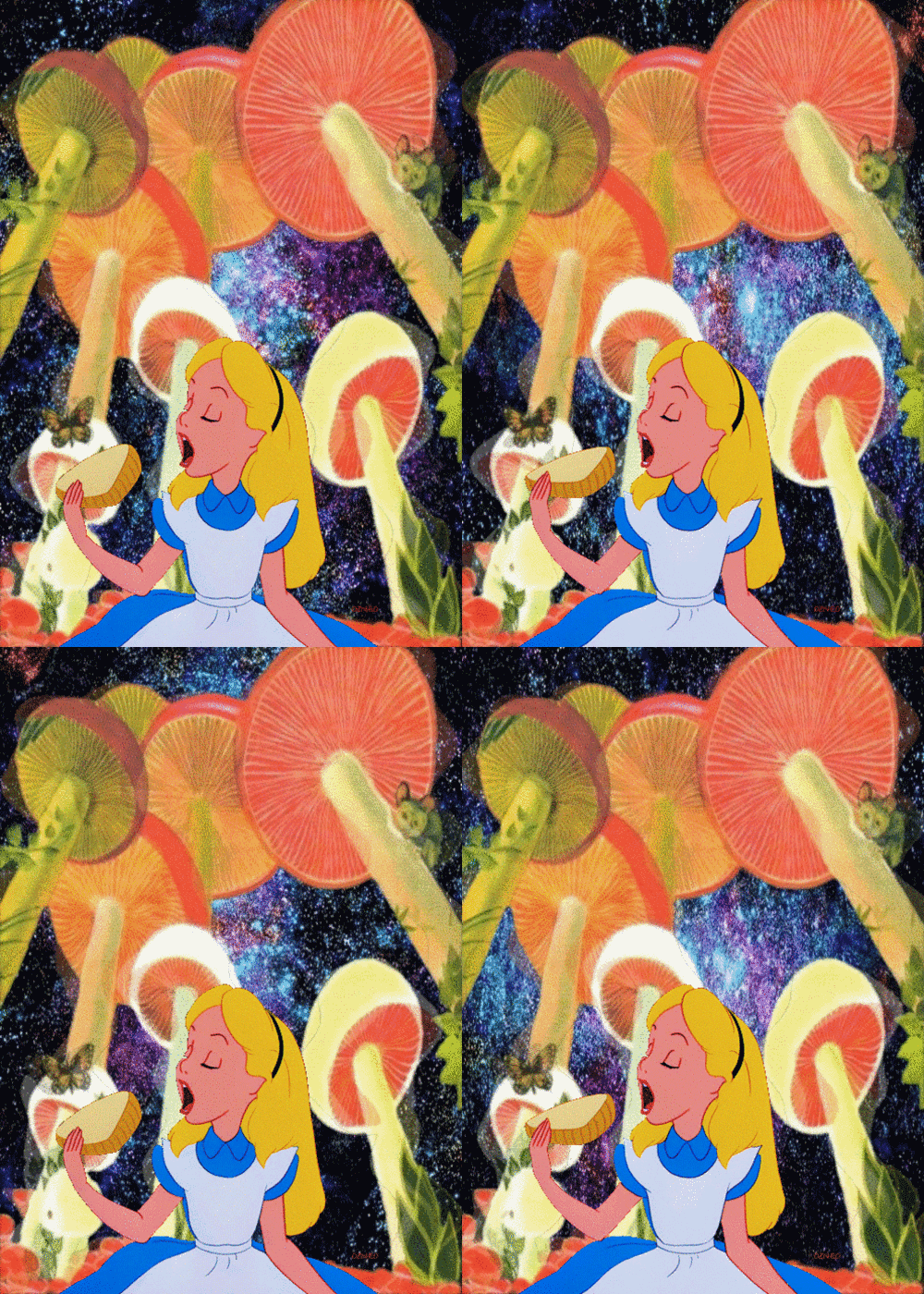
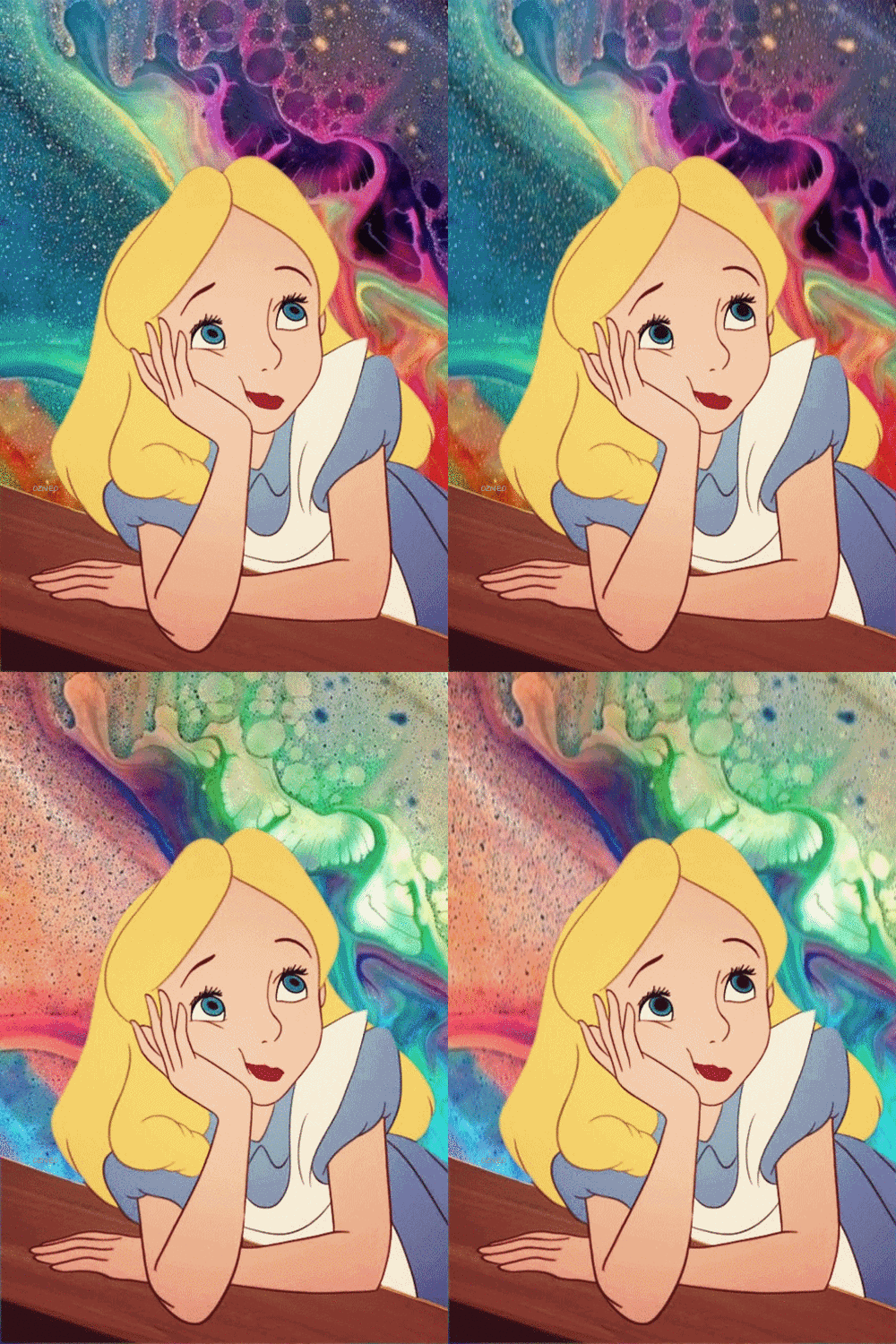
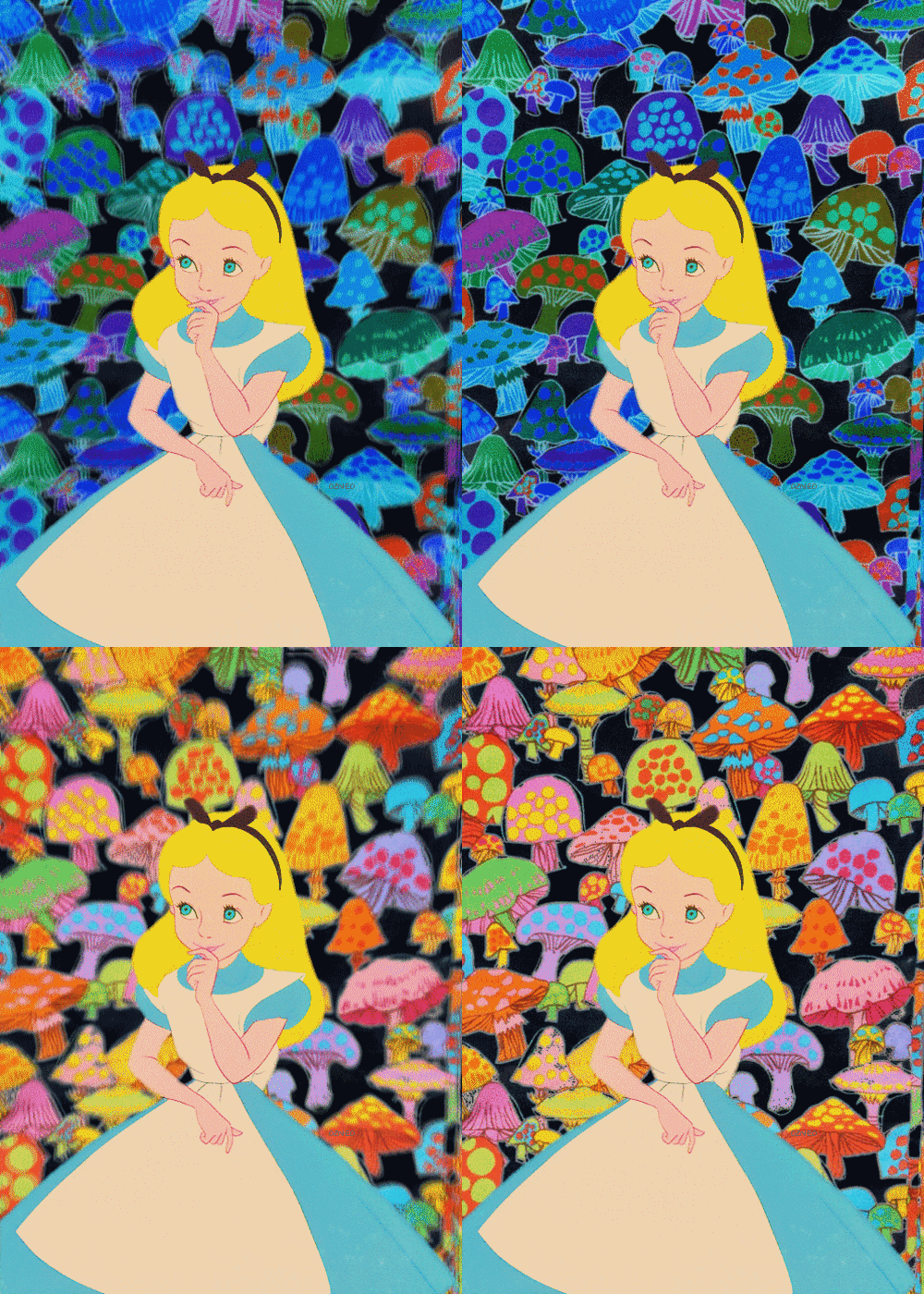
In the 1960s, Alice in Wonderland was reinterpreted through the lens of psychedelic culture, largely due to the influence of the song "White Rabbit" by Jefferson Airplane. The song, released in 1967, explicitly connected Alice with drug use, referencing elements from the book like the White Rabbit and Alice's journey. This connection made Alice a mascot of the 60s counterculture, associating her with the psychedelic experience, particularly LSD.
Psychedelic posters of Alice from this era often featured vibrant colors, surreal patterns, and imagery that mirrored the idea of a "mind trip," aligning with the distorted realities in the story. Elements like the caterpillar smoking a hookah, the mushrooms that change Alice’s size, and the "Eat Me" cake became symbols of the effects of hallucinogens.
While there's no evidence that Lewis Carroll intended these references, the psychedelic interpretation became a significant cultural reading of the story. Alice’s journey through Wonderland was seen as analogous to a drug trip, making the character an enduring icon of the 1960s and 70s counterculture, with its focus on breaking conventions and exploring altered states of consciousness.
Thanks to Alan Tannenbaum, who sent me the pictures.
Antônio Peticov é um artista plástico brasileiro com intensa produção em diversas mídias e linguagens com ênfase na pintura. Em seu imaginário se alimenta de um vasto repertório de referências da história da arte à cultura pop, da geometria sagrada aos objetos impossíveis, promovendo um encontro entre a intuição e a geometria, o sonho e a matemática.
A obra de Lewis Carroll, em especial os livros de Alice, influenciaram a obra de Peticov desde a década de 70. O que mais o entusiasma nos livros de Alice? A ousadia e a coragem da heroína de enfrentar o desconhecido. Para ele, as duas obras mostram uma realidade psicodélica que promove a expansão da consciência e a liberdade de expressão.
Peticov é também um metagrobologista, um estudioso e colecionador de quebra-cabeças. Ficou fascinado ao conhecer a obra do matemático Martin Gardner, especialista em Lewis Carroll, ao ler o clássico Annotated Alice em sua juventude, o que aumentou seu interesse pelo matemágico mundo dos puzzles.
Viajou nas últimas décadas pelos sonhos de Alice em grandes telas que dialogam com as ilustrações clássicas de John Tenniel incorporando figuras de artistas como Escher, Penrose, Edgard Rubin, entre outras imagens enigmáticas de geometrias impossíveis, ilusões visuais, paradoxos, objetos surrealistas.
Também viajam nas imagens, suspensos em uma gravidade onírica, outros objetos presentes na obra de Carroll, que criam um quebra cabeça que convida o público a decifrar.
A Rainha Branca do xadrez do espelho também está presente em algumas telas. A própria Alice se transforma em Rainha no final do livro do Espelho e a Rainha Branca torna-se ao mesmo tempo um símbolo da crença no impossível e um avatar de uma Alice metamórfica e onironauta. O Coelho Branco viaja através de várias imagens de Peticov. Ele está de costas para nós indo em direção a sucessivos portais multidimensionais.
Espelho, toca, fechadura, janela, porta, buraco negro ou de minhoca. Segundo ele, a presença do dia e da noite, das luzes e das sombras em seus portais simbolizam o caminho de mão dupla entre o consciente e o inconsciente, movimento incessante da arte e da produção de conhecimento. O Coelho Branco atua como um psicopompo, pois caminha entre mundos e convida o público a atravessar o limite da tela e viajar pelo desconhecido em uma experiência alicedélica.
obras: Antonio Peticov
Antonio Peticov
Antonio Peticov
Antonio Peticov / detalhe
"As telas de Antonio Peticov criam portais para um outro espaço tempo aonde a Rainha Imaginação e o Rei Pensamento nos convidam para alicinar também".
Alice Alicedélica
"Em seu diálogo com Lewis Carroll e Martin Gardner, Peticov cria enigmas matemágicos que nos desafiam a desmontar os saberes instituídos e estagnados e criar caminhos para novas amaravilhas sem fronteiras entre o sonho e a realidade".
Alice Alicinógena
“Nas alicinações de Peticov as ilustrações originais de John Tenniel sairam do livro de histórias vitoriano para um mundo onírico de metamorflores onde tudo era diferente. Nada era o que é e tudo era o que não é. E, para mim, tudo o que é, por sua vez, não seria. E o que não fosse, seria. Não é?"
Alice Alicinante
"Inspired by Cinderella and Alice in Wonderland, the designing duo behind Romance Was Born (Anna Plunkett and Luke Sales) created a psychedelic collection that took a bite out of both sides of the mushroom. It was equal parts whimsical and wacky, magical and mad, presenting Cheshire Cat jumpsuits, princess-themed dresses and mushroom-embellished sweaters on a set so sweet it could have given you a toothache. Literally, in fact, given that it was made out of sugar by sugar-craft artist Tanya Schultz of Pip and Pop." found at maisonmouse
Alicedelic Alices from 60'.
my dearest:
selection in progress:
Joe McHugh, 1967.
Joe McHugh, 1967.
Joe McHugh, 1967.
Joe McHugh, 1967.
Cathy Hill
Cathy Hill
Blotter Acid sheet:
"Psychedelics, Baby! The Psychedelic Interpretation, more than some of the others, has its roots in popular culture, specifically with Jefferson Airplane’s “White Rabbit.” The lyrics, written by Grace Slick, include a lot of Alice imagery, as well as some not-so-subtle drug references, which nevertheless were subtle enough to make it past the radio censors in 1967. The song was enormously popular and inspired many other artists to explore the connection between Alice and recreational drug use, until Alice was essentially the mascot of ‘60s and ‘70s drug culture. In fact, as Scott Parker points out, “the association of drugs with Alice is so established that alice is now a slang term for LSD” (138)."
continue reading about Psychedelic Interpretations of Alice in Wonderland at Curiouser and curiouser the Evolution of Wonderland
Welcome to a wonderful Alice film produced in 1971 by the US Department of Health Education. Its funny to see how its supposed educational anti-drugs message is almost silenced by the creative dynamics of colors, and rhythms and sounds. We know how much the explorations of connections between Alice and drugs have induced misunderstandings, prejudices and stereotypes, but also open paths to jump into an imagery of surreal dreamscapes, opening minds to other realities and states of consciousness and desires of transformation. This is an amazingly beautiful Alice journey into psychedelic wanderlands. If the text suggests a moral, the images invites us to a trippy and daring play of animation, moving sensual environments, collages mixing drawings and photographs in unpredictable angles and points of view, suggesting a permanent disturbance of gravity and consensual realistic representations. It is a lovelier and mad and curiouser invitation for enigmagic innerlands. At the end we can recognize that it overcomes all drug connections revealing the playfulness of art and imagination itself in its call for freedom and joy. "She ate a little bit, and said anxiously to herself, `Which way? Which way?', holding her hand on the top of her head to feel which way it was growing, and she was quite surprised to find that she remained the same size: to be sure, this generally happens when one eats cake, but Alice had got so much into the way of expecting nothing but out-of-the-way things to happen, that it seemed quite dull and stupid for life to go on in the common way." Alice in Wonderland
"In Curious Alice (1971), a film intended for eight to ten year olds, our young Alice falls asleep while reading a book. She encounters cigarettes, liquor, and medicines, and realizes that they are all types of drugs. When she sees the “Drink Me” bottle, she understands that it contains something like a drug, yet after a half-second’s consideration, she drinks the entire bottle and enters a fantasy world. In Drug Wonderland, Alice learns about the hard stuff from her new friends the Mad Hatter (LSD), the March Hare (amphetamines), the Dormouse (barbiturates), and the King of Hearts (heroin). The events of Curious Alice play out as an expression of Alice’s drug trip. Unfortunately, the trip is kind of fun and effectively cancels out the film’s anti-drug message." (...) "In the 1972 publication, Drug Abuse Films, the National Coordinating Council on Drug Education (NCCDE) criticized Curious Alice for being confusing and potentially counterproductive to drug abuse education. In the report, the NCCDE, an independent organization that received funding from NIMH, evaluated scores of films for scientific accuracy and effectiveness. The review panel classified Curious Alice as “restricted”, writing that young viewers “may be intrigued by the fantasy world of drugs” and that it should only be presented with a “very skilled facilitator” in order to “probe for the drug attitudes” of an elementary school class. (In other words, teachers, don’t bother trying to use this film to get kids to stay away from drugs because it’ll require way too much extra work on your part.) For the record, Curious Alice was by no means singled out for criticism– the NCCDE recommended only about 16% of the films they reviewed for widespread use"
continue reading: The Curious Case of Curious Alice
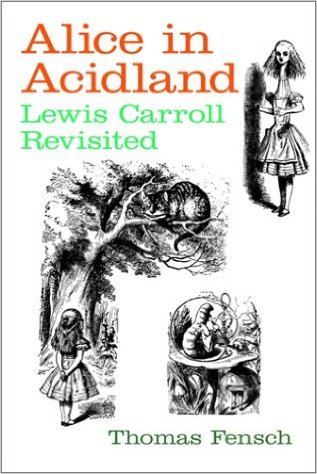
"Alice and the 1960s were a natural mix - the radical world-view they shared, the identifications with the bizarre, surreal, the anti-authoritarian - and both enjoyed a fine sense of humor. Alice and her friends, particularly the hookah-smoking caterpillar, became popular icons in this decade, spawning posters, belt-buckles, blotter paper "acid", books (Thomas Fensch's fallacious Alice in Acidland, Barnes, 1970) and rock songs ("White Rabbit") by people who clearly never read the book. More unfortunately, some of the deluded populace were unable to believe that a writer could be inspired by the creative imagination alone, and so quite erroneously imputed drug use to this mild-mannered Victorian clergyman who never touched anything stinger than sherry." Mark Burstein
President of Lewis Carroll Society of North America foreword to "Alice's Adventures under Ground" by Lewis Carroll. San Francisco: Cottage Classics, 2000.
Alice Down the Rabbit Hole
(a1966; 18 x 24" acrylic painting)
Adrian Piper
Alice and the Pack of Cards
(1966; 18 x 24" acrylic painting)
"In her younger years, still in high school, she created paintings that were discovered later on in life and became known works. For instance "Alice Down the Rabbit Hole". They are considered Adrian's LSD paintings. She began to understand the principle of Conceptual art. The media she chooses to use is painting, sculpture, drawing, performance, video, installation, sound works and photo documentation. Having it being her first generation as a conceptual artists she began to introduce herself into yoga and meditation. This was something she wanted to achieve personally. Her goal was to explore her consciousness, perception, and infinite permutation using maps, diagrams, photographs, and descriptive language. After this she went onto exploring Minimalism. "Alice Down the Rabbit Hole" created on canvas board."
"The New Historical approach not only examines the era in which a work of literature was created, but also recognizes that later eras can assign meaning to a work based on their own culture and circumstances (Tyson 295). Thus a New Historical critic, when interpreting Alice, would look not only to how men and women in the Victorian Age would have understood Alice, but how later interpretations reflect the concerns and interests of later historical eras. One of these later interpretations works well as an example, both because of its clear roots in a specific culture and its persistence as a popular interpretation: the Psychedelic Interpretation." (...)
"The Psychedelic Interpretation, more than some of the others, has its roots in popular culture, specifically with Jefferson Airplane’s “White Rabbit.” The lyrics, written by Grace Slick, include a lot of Alice imagery, as well åas some not-so-subtle drug references, which nevertheless were subtle enough to make it past the radio censors in 1967. (Click here to listen to the song) The song was enormously popular and inspired many other artists to explore the connection between Alice and recreational drug use, until Alice was essentially the mascot of ‘60s and ‘70s drug culture. In fact, as Scott Parker points out, “the association of drugs with Alice is so established that alice is now a slang term for LSD."
Lewis Carroll's Alice's Adventures in Wonderland: With Artwork by Yayoi Kusama is produced in collaboration with the Kusama Studio, Tokyo and Gagosian Gallery.
Many years later, during a huge exhibition of her work at TATE modern, Yayoi Kusama illustrates Alice. My book has just arrived. It's beautiful! The images are are full of energy and the graphic design is vibrant and stimulating. Well, I love Alice and adore Yayoi Kusama. The dots present throughout Kusama's works travels in the pages of the book, like Alice in a world where the boundaries between dream and reality, between text and image are recreated. It defies boundaries of pages playing with some typographic games, following Alice's transformations. My favorite images at the moment are the fall of Alice and the pool of tears, both presented bellow. They are pure pulsation, with Kusama's powerful dots, being suggestive and mysterious. For me the first presents the fall itself instead of Alice following. We can also fall when we look at it. The second is a crying state instend of Alice crying . The book comes with some new pictures and some previous images of her career, making connections between text and images most time not so clear. Anyway, it is another exciting meeting between Kusama and Alice.
Yayoi Kusama
Yayoi Kusama
"I, Kusama, am the modern Alice in Wonderland", stated in the 60' the Japanese artist Yayoi Kusama, who since the 1950s has alicinated psychedelic worlds. In paintings, collages, poems, daring acts, texts, sculptures, fashions, and surprising installations, she shares patterns, repetitions, obsessions, and visions of the infinite.
In the 1960s, the artist went to New York, where she carried out a series of political happenings, under the philosophy “Love forever,” promoting a reaction against the Vietnam War and all authoritarian, repressive, and conservative powers. Some of ehese body paintings and orgiastic choreographies were performed before the sculpture of Alice in Central Park, in 1968. For Kusama, Alice was the grandmother of the hippies.
Kusama arrived in Central Park as the Hatter, with her nude dancers, inviting everyone to drink the tea that was being served under the magic mushroom. Red, green, and yellow dots could represent the earth, the sun, or the moon, according to Kusama. She painted little circles on the bodies of those present, so that people would divest themselves of their outlines to return “to the nature of the universe”, incorporating an almost hallucinatory vision of reality, in an experience that is at once sensory and spiritual.
Pay attention to the graphic design of Stefanie Posavec, one of today’s most creative information patternists. She makes Kusama's dots play around the pages and over the text creating a new and exciting game between pictures and conversations.